The homepage told you what Sofia does. This is how — every step, every rule, everything Sofia automates and everything it deliberately doesn’t.
A lead arrives from any source — Facebook, website form, walk-in, referral, property portal, door-to-door. Nobody’s spoken to the client yet. The source is recorded, and reports break performance down by source.
The moment a real communication is logged (a call, WhatsApp), Sofia moves the lead here on its own — nobody changes it by hand. First-contact time is recorded and measured, not guessed at.
The lead has moved on to viewing a property. The visit itself is verified with GPS and a photo — detail in the next section.
A lead sits here once an offer has gone out (Draft → Sent → Negotiating → Agreed) or price/terms are actively being discussed. The moment an offer reaches Agreed, the unit is automatically held — off the market, though no money is in yet.
Once booking money is actually recorded, the unit becomes Sold and the lead moves to Booked — the moment a reservation turns into a real, paid commitment.
The deal is finalised — but only if there’s a real offer behind it (Sent, Negotiating, Agreed, or Booked). Sofia blocks closing a lead with nothing to show for it.
A lead can be marked Lost from any stage — but never without a real reason; Sofia won’t let that be skipped. It also quietly records which stage the lead was in when it was lost, so reports can later show how far leads typically get before falling through.
| What Sofia can do | What Sofia can’t do |
|---|---|
| Unit availability updates itself | Property price (set by the stakeholder) |
| Property matching against a client’s real stated budget, ranked by fit — not by commission | Final negotiation and offer terms (human) |
| Follow-up reminders when a lead goes quiet | The client’s own conversation |
| 14 one-tap “Smart Answers” cards — who needs a follow-up today, which deals are stalling, which bookings are incomplete | — |
| 24+ reports assembled from recorded activity | — |
| Stage-slip detection (never contacted, no next step, gone quiet) | — |
| A real Top / At risk / Failing score for every person, calculated from target, pipeline, closing recency and contact behaviour | — |
Whatever no system or AI can do, Sofia can’t do either. Sofia’s job is to remind you, flag your mistakes, and give you suggestions.
Whether a site visit actually happened, what stage a client is really at — that isn’t the salesperson’s word for it. It’s what the system recorded.
Starting a visit means the agent checks in — a photo and GPS location are captured immediately. While the visit is underway, location is logged roughly every four minutes, and checking out captures the same thing again — photo, GPS, and the real duration of the visit. The client then gets a WhatsApp link to independently confirm the visit actually happened. Impossible travel time, a suspiciously short visit, or a client who never confirms — anything unusual is automatically flagged for a manager to review. No other property CRM in this market ties a site visit to independent, client-side confirmation this directly.
Sofia has built-in call, WhatsApp and email tools — for the salesperson’s convenience, not to message clients on Sofia’s own initiative. When a salesperson uses them to make contact, that moment — when, on which channel, how long after the lead came in — is logged automatically. “I followed up” stops being something only the salesperson can claim; the system has the timestamp.
Sofia is sales-only — it doesn’t conflict with your ERP.
Naming the boundary explicitly is what a technical evaluator looks for before recommending it internally.
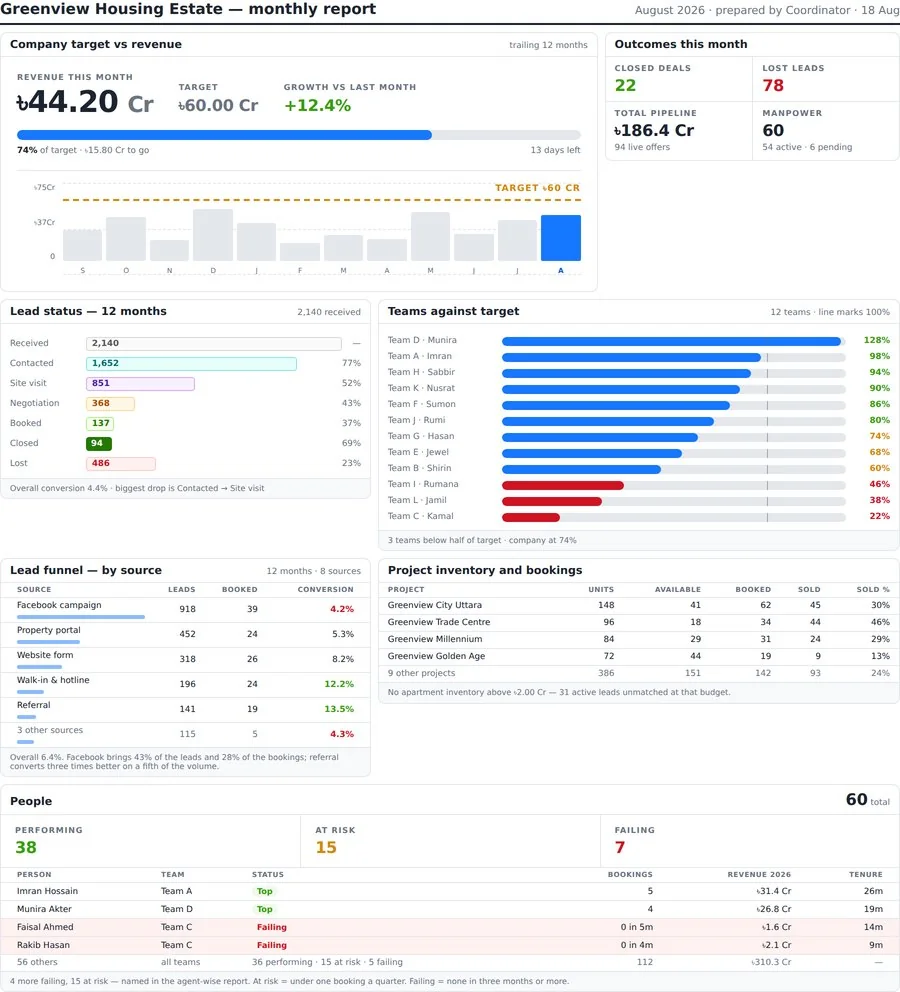
A one-page monthly report — target vs. revenue, lead funnel by source, teams against target, project inventory. Behind it sit 24+ built-in reports — pipeline, commission, source performance, funnel conversion, inventory sell-through, and more — each exportable to Excel, automatically scoped to what that person is allowed to see.
No taka is guessed — only counted numbers you can check.
